


GEO (Generative Engine Optimization) is the latest development in SEO and the AI world.
It is changing the way people gather information online. GEO is also creating a big impact on websites that rely primarily on search traffic.
So, if you’re a marketer, SEO, or a website owner looking to stay ahead of your competition, adapting to GEO is extremely important.
In this guide, we’ll discuss;
- What is GEO in AI, and why is it essential for businesses in 2026
- Difference between traditional SEO and GEO
- How does it work
We’ll also walk you through how you can optimize your content for GEO. Let’s get started.
What Is GEO In SEO?
GEO in SEO is simple to understand. Let’s start with the basics.
GEO stands for Generative Engine Optimization, which refers to optimizing your content so it can appear in AI-generated answers. In simple terms, GEO in SEO focuses on helping your website get mentioned when AI platforms generate responses to users’ questions.
GEO is all about optimizing for AI platforms like ChatGPT, Perplexity, Gemini, Copilot, and Google AI Overviews.
The primary goal of optimizing for GEO is to appear in AI answers, improve your brand’s visibility, and ultimately attract visitors from AI platforms to your website.
What is the Difference Between GEO and SEO?
Here’s a simple table showing the key differences between traditional SEO vs GEO.
| Feature | SEO (Search Engine Optimization) | GEO (Generative Engine Optimization) |
| Primary Goal | To rank higher in search engines (Google, Bing, etc.) | To be included in AI-generated answers (ChatGPT, Gemini, etc.) |
| Primary Audience | Mostly using search engines to find comprehensive data/answers | Mostly using AI tools to find information quickly |
| Primary Content | Blog posts, in-depth guides, case studies, reviews, etc | Conversational content that’s accurate and up-to-date |
| Example | Ranking for “best SEO tools” on Google | Being mentioned when someone asks an AI, “What are the best SEO tools for 2026?” |
SEO
Here’s an example of a traditional SEO search result;
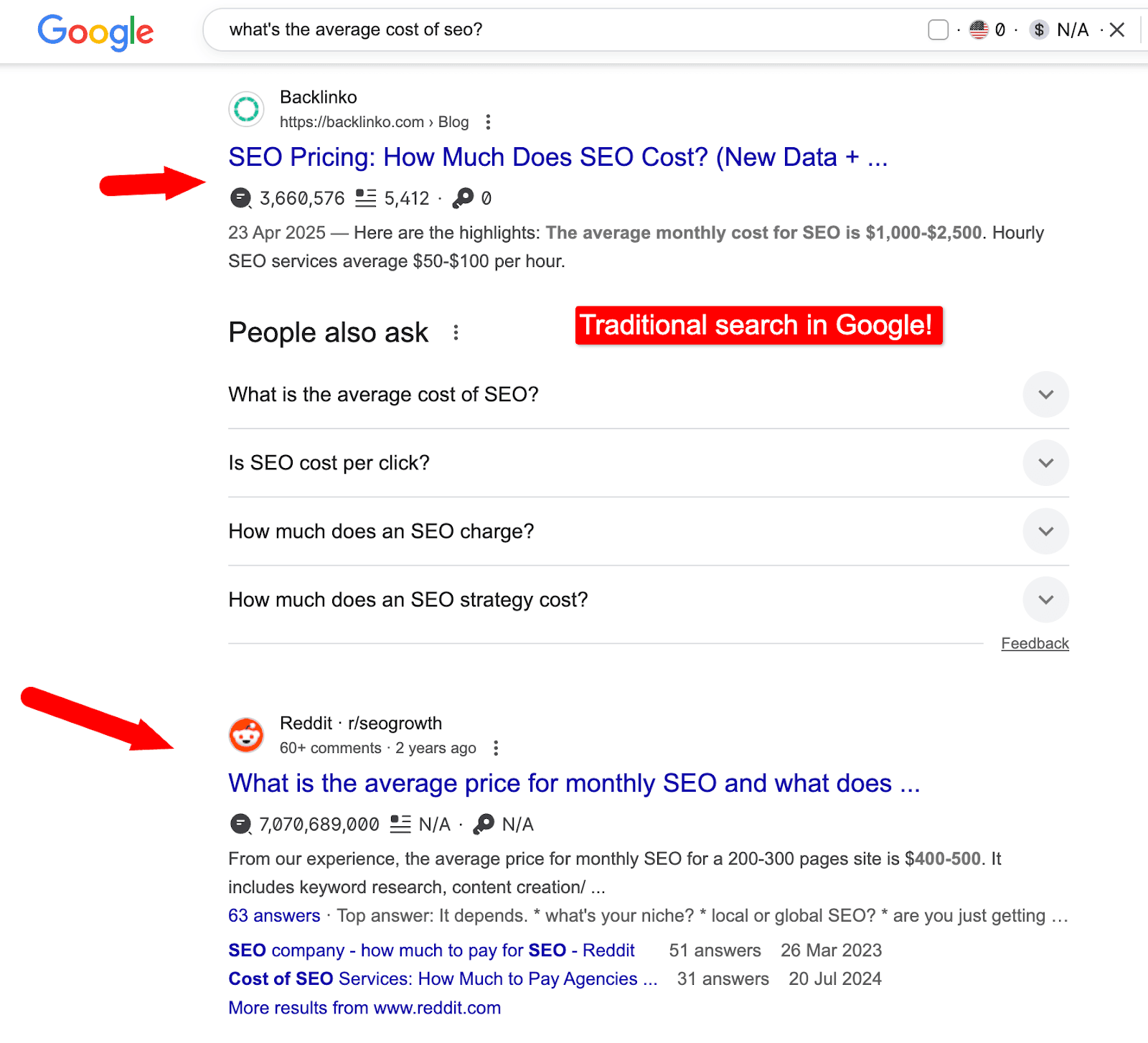
As you can see above, traditional SEO search results typically contain a list of pages with links to specific sites, allowing users to find more information.
Here are 11 different types of SEO explained in detail so you can understand which ones to use to boost your search traffic.
GEO
Here’s an example of a GEO AI answer in ChatGPT;
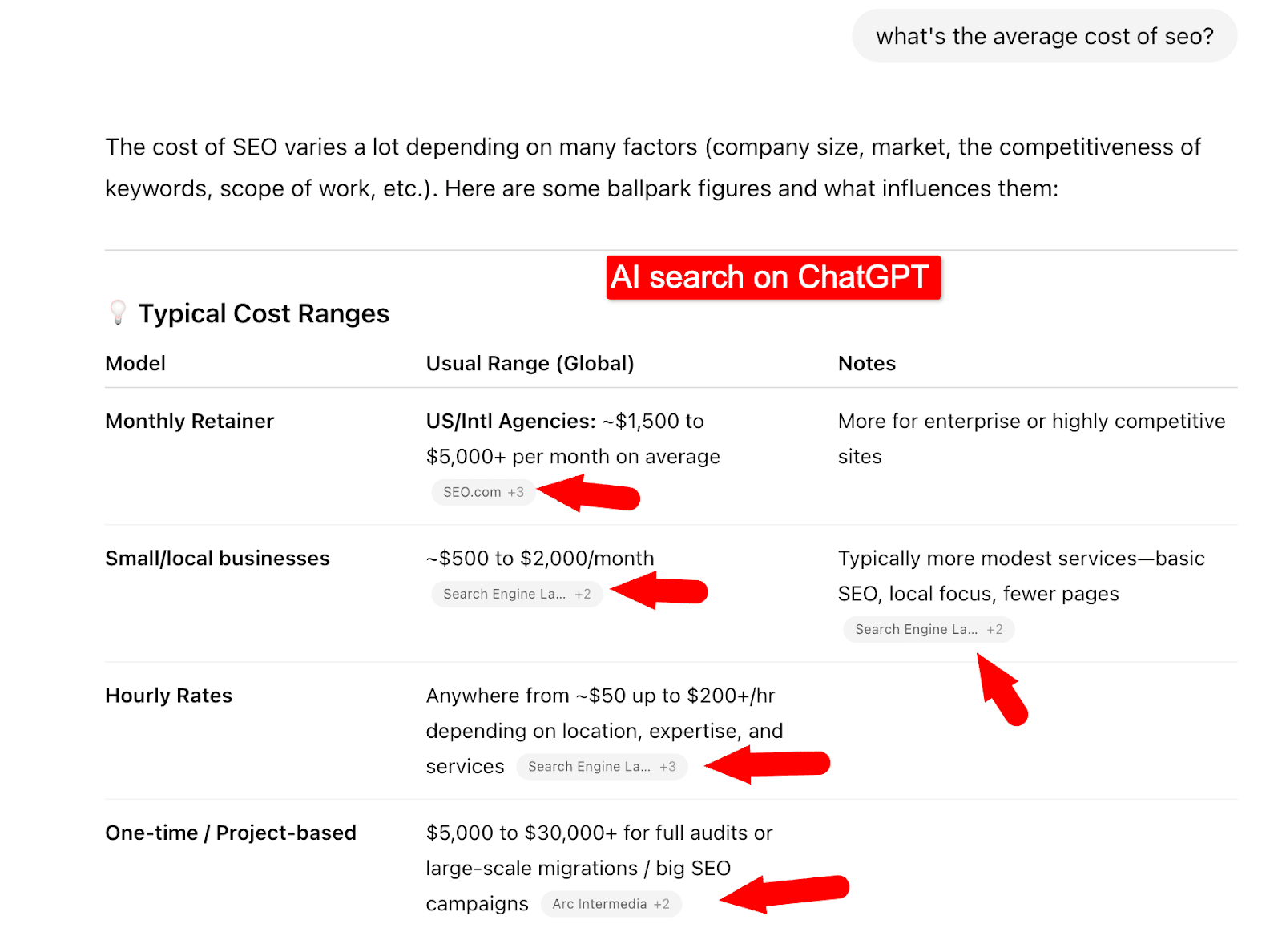
As shown above, unlike SEO, you’ll find content inside AI-generated answers in GEO. Sometimes, these AI-generated answers also display credit links to the original source, providing you with more visibility (as shown above).
Why is GEO in SEO Important in 2026?
Here are some of the biggest benefits of optimizing your website’s content for GEO in 2026.
- Increased visibility for your brand or website in various AI platforms, including ChatGPT, Perplexity, and Gemini.
- You’ll get a better edge over your competitors in terms of brand building, as GEO is still in its early stages!
- If done right, you’ll not only appear in search results but also in AI platforms, leading to a wider reach.
- GEO ultimately helps build trust and authority
If you’re learning about GEO, you should also take a look at what AEO means in SEO.
How does GEO Work?
GEO basically involves getting your website’s content cited in AI answers.
Here’s how Generative Engine Optimization (GEO) works;
- Data collection: The AI platforms, such as ChatGPT, collect massive amounts of information from trusted sources to build a massive knowledge base. For example, collecting information on “Best SEO tools” from product reviews, blog posts, etc.
- User queries: The AI understands the questions people ask. For example, a user types, “What’s the best SEO tool under $100?”
- Synthesizing content: The AI summarizes the main points into direct answers. For example, it generates answers like “Semrush offers the best features under $100, based on expert reviews.”
Here is a simple explanation:
Content → Structured Data → AI Training Signals → AI Citation → Brand Visibility → Traffic
Strategies to Implement GEO in 2026
GEO is still in the earlier phases, unlike SEO, where we already know how to optimize a website. However, here are some of the best strategies you can implement to optimize content for generative engines.
Analyze how AI tools generate answers
Before creating content, make sure to study how AI platforms like ChatGPT, Gemini, or Perplexity provide answers to the topic you’re covering.
Most AI platforms generate answers by using a technique called “Natural Language Processing (NLP)”.
NLP allows generative engines like ChatGPT to understand user queries in everyday language and give relevant answers in a conversational way.
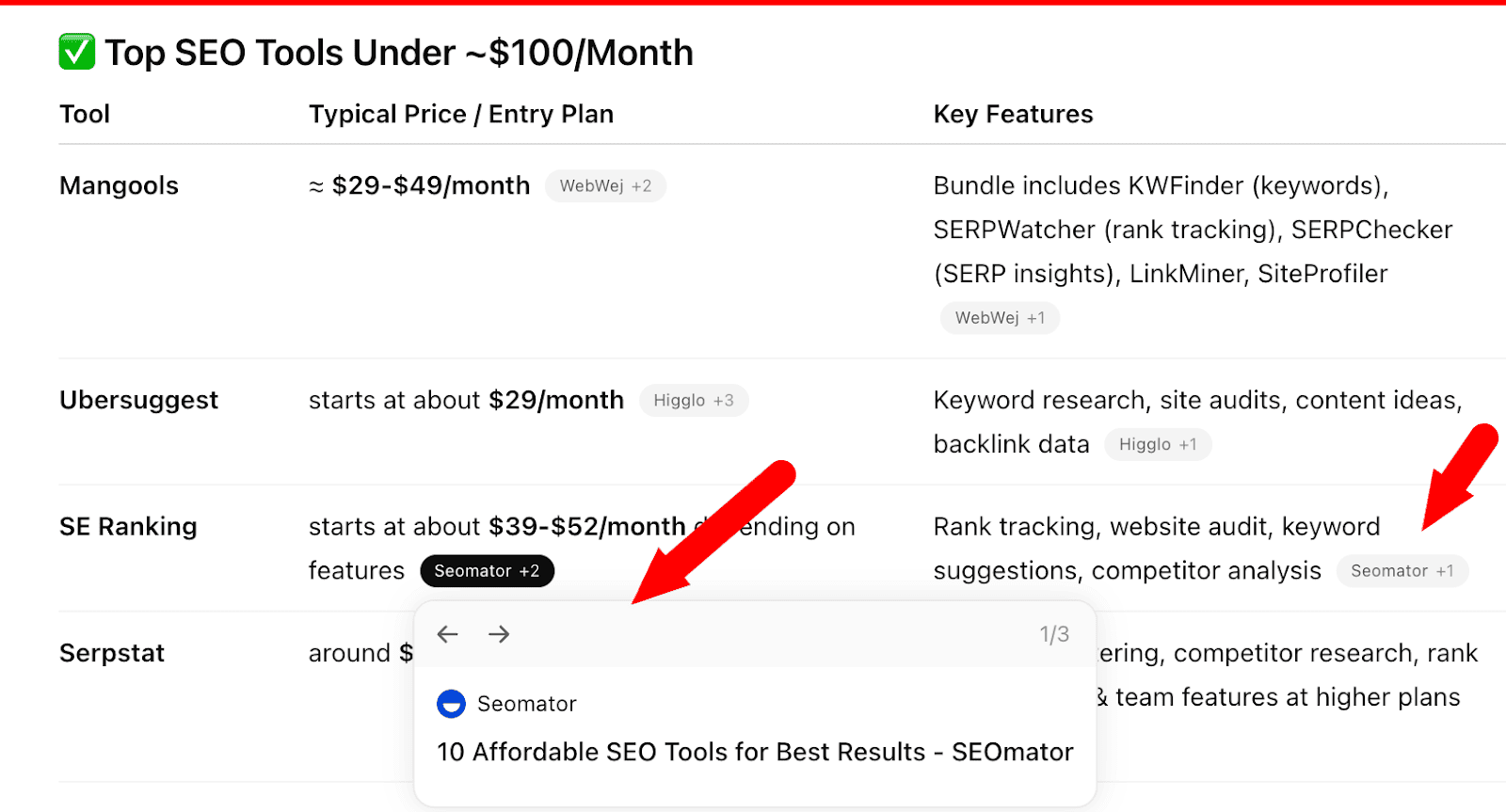
For example, when asked for “best SEO tools under $100,” ChatGPT displays a table showing the top tools under $100/month.
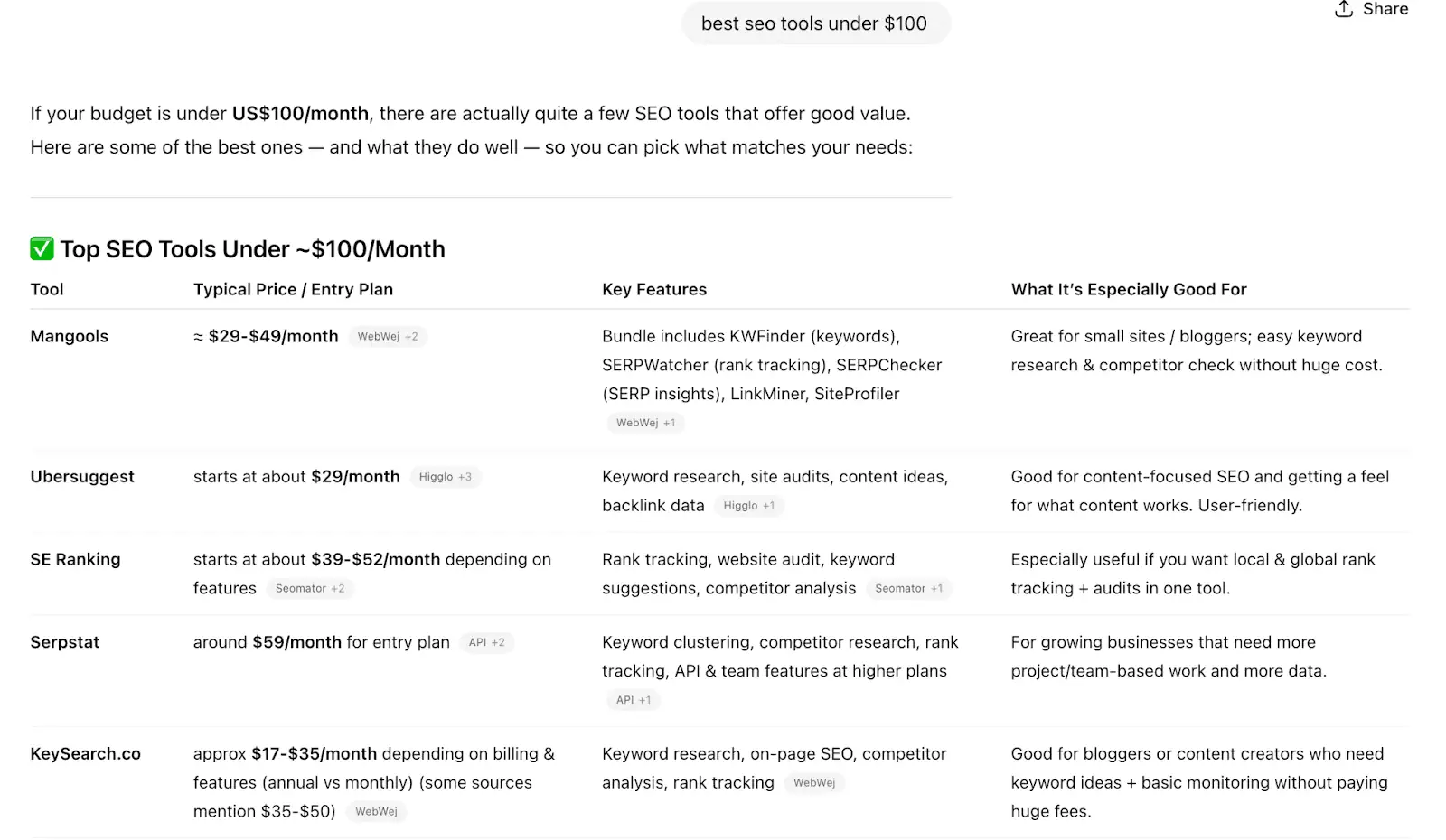
As illustrated in the above example, AI offers a straightforward and intuitive way to compare multiple options and quickly identify the best fit.
So what can we learn from the above example?
For specific queries, AI platforms don’t just provide random answers, they summarize multiple sources or highlight lists to make it easy for users to understand.
If your content is structured correctly, factual, and well-formatted (with FAQs, lists, tables, etc.), your content will appear and be cited in AI answers.
In the above example, ChatGPT’s generative engine displayed Seomator’s blog post within its answer.
Upon analyzing the post from Seomator, it is well-structured, featuring question-based and descriptive subheadings.
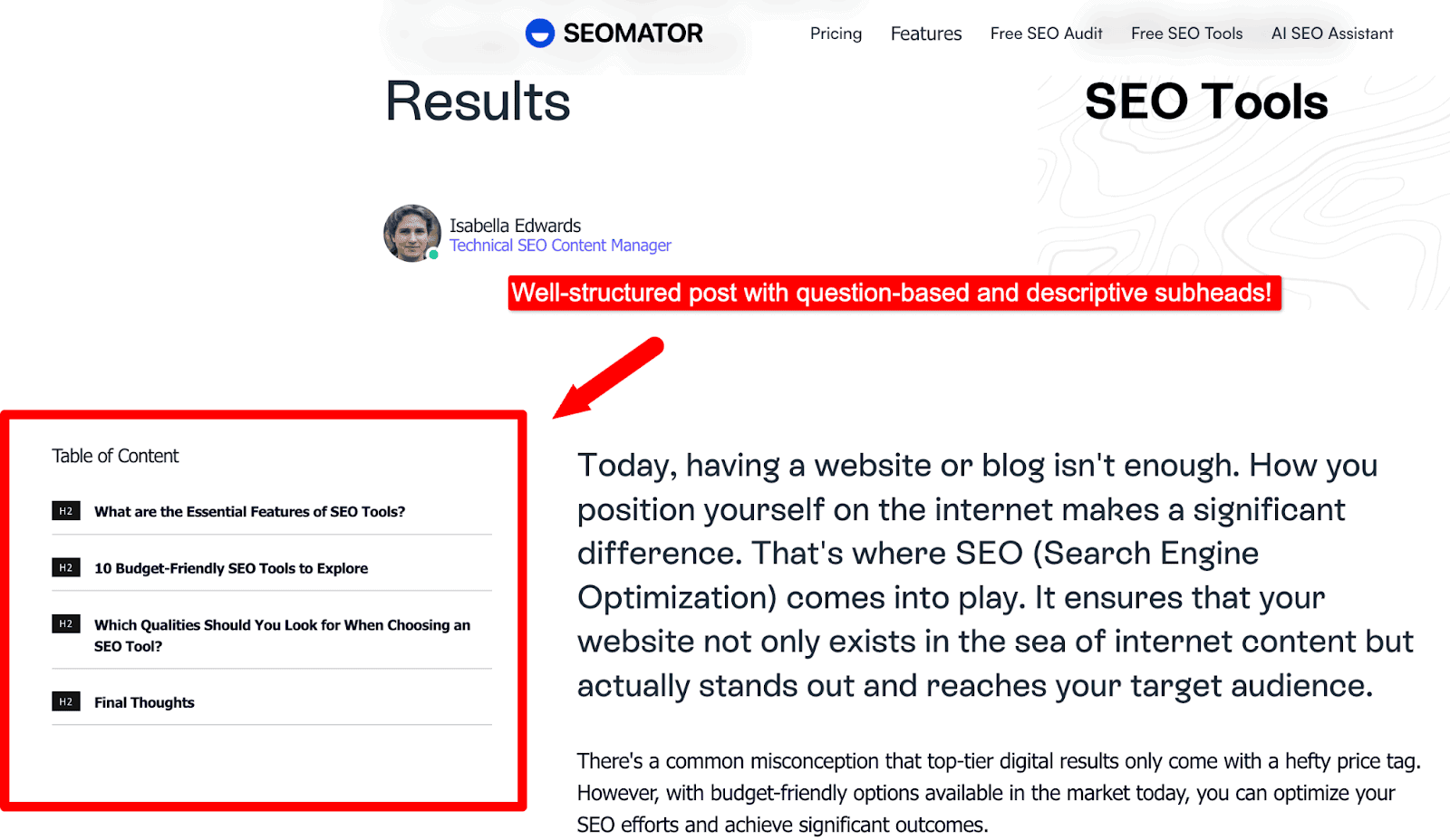
That’s why generative engines like ChatGPT are able to easily understand content and answer the user queries in a simple way.
Structure your content with clear headings
Here’s the thing: you need to craft your content properly to be able to rank in AI answers.
Unlike search engines that primarily focus on backlinks, keyword usage, and technical SEO factors, generative engines prioritize clarity and how well your content directly addresses users’ queries.
Generative engines always look for clarity, structure, and relevance in a webpage.
So, how can you craft your content to optimize it for AI engines?
Start with descriptive subheadings, including H1, H2, H3, etc. Use your content’s subheadings to break down the topic into easy-to-read sections.
For example, if you’re writing a blog on “Best SEO Tools for Beginners”, break it down with subheadings like What Are SEO Tools?, Top 5 SEO Tools Under $100, and How to Choose the Right Tool.
Most importantly, try to answer users’ questions as quickly and clearly as possible. Use FAQs and bullet points so AI platforms can easily extract information.
Example: A blog post on “SEO Tips That Work in 2026” might be structured logically in the following format;
- H1: Top 25 SEO Tips That Work in 2026
- Intro: 1–2 lines explaining why SEO matters
- H2: Outlining key SEO tips that actually matter
- H3: Break down each tip with simple and clear explanations
- FAQ section: To target relevant question keywords
- Conclusion: Summarize tips and encourage action
SEO is changing the way we optimize websites. Here are 11 key predictions about the future of SEO.
Focus on improving EEAT signals
EEAT stands for Experience, Expertise, Authority, and Trustworthiness.
If you want your content to show up in generative engines, you must improve your website’s EEAT signals.
Generative engines always look for content that’s written by experts and is credible.
That’s why adding credentials, showing testimonials, customer reviews, citing reliable sources within your content, updating your content regularly, etc, helps in GEO.
Take our own blog BloggersPassion.com as an example, where we show EEAT signals through;
- Experience: Anil Agarwal (the founder of the blog) has over 15 years of experience in blogging, SEO, and digital marketing.
- Expertise: Almost all the articles we publish are written by experts and offer practical tips to readers.
- Authority: We often cite credible sources like Semrush, Backlinko, Ahrefs, etc, while creating content. Also, we have built backlinks from hundreds of high-quality sources.
- Trustworthiness: Our contents are regularly updated with fresh information, and we often provide honest recommendations and clear affiliate disclaimers.
Similarly, you can also build EEAT on your own site by showcasing real experience, providing helpful advice, linking to credible sources, and building high-quality backlinks.
According to our SEO guide that includes basics and a 5-step plan to improve your rankings in 2026.
Add Schema Markup to Your Website
A schema markup helps search engines and AI platforms understand the meaning behind your content.
For example, if you’re writing a product review on “Semrush review”, you can implement a Review Schema that includes key details like product name, rating, pros/cons, and author.
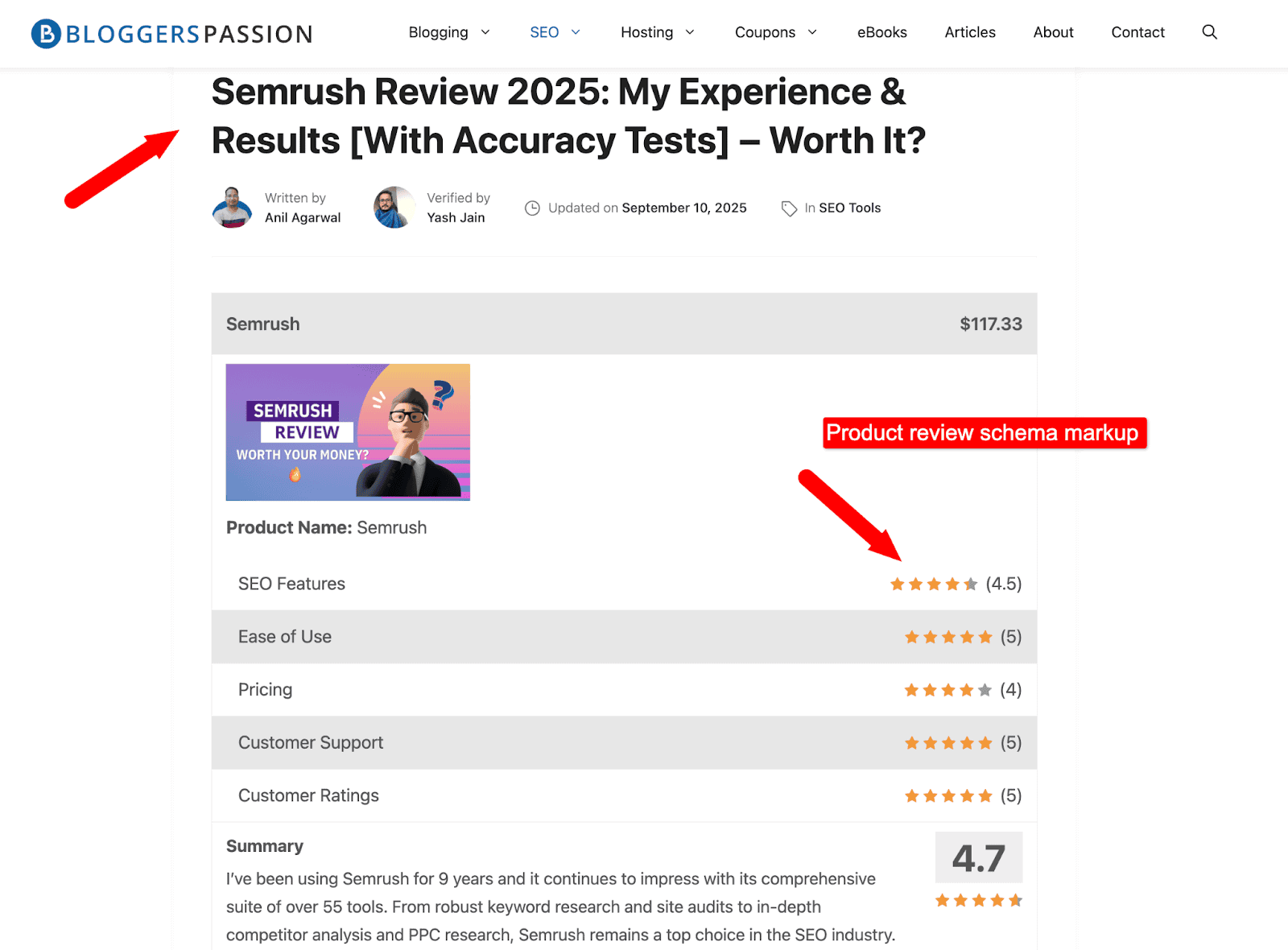
That way, when someone asks AI, “Is Semrush worth it?”, the generative engine can show a summary of your product review like, “Semrush is excellent for keyword research (rated by 4.7 by Anil) but can be expensive for beginners”.
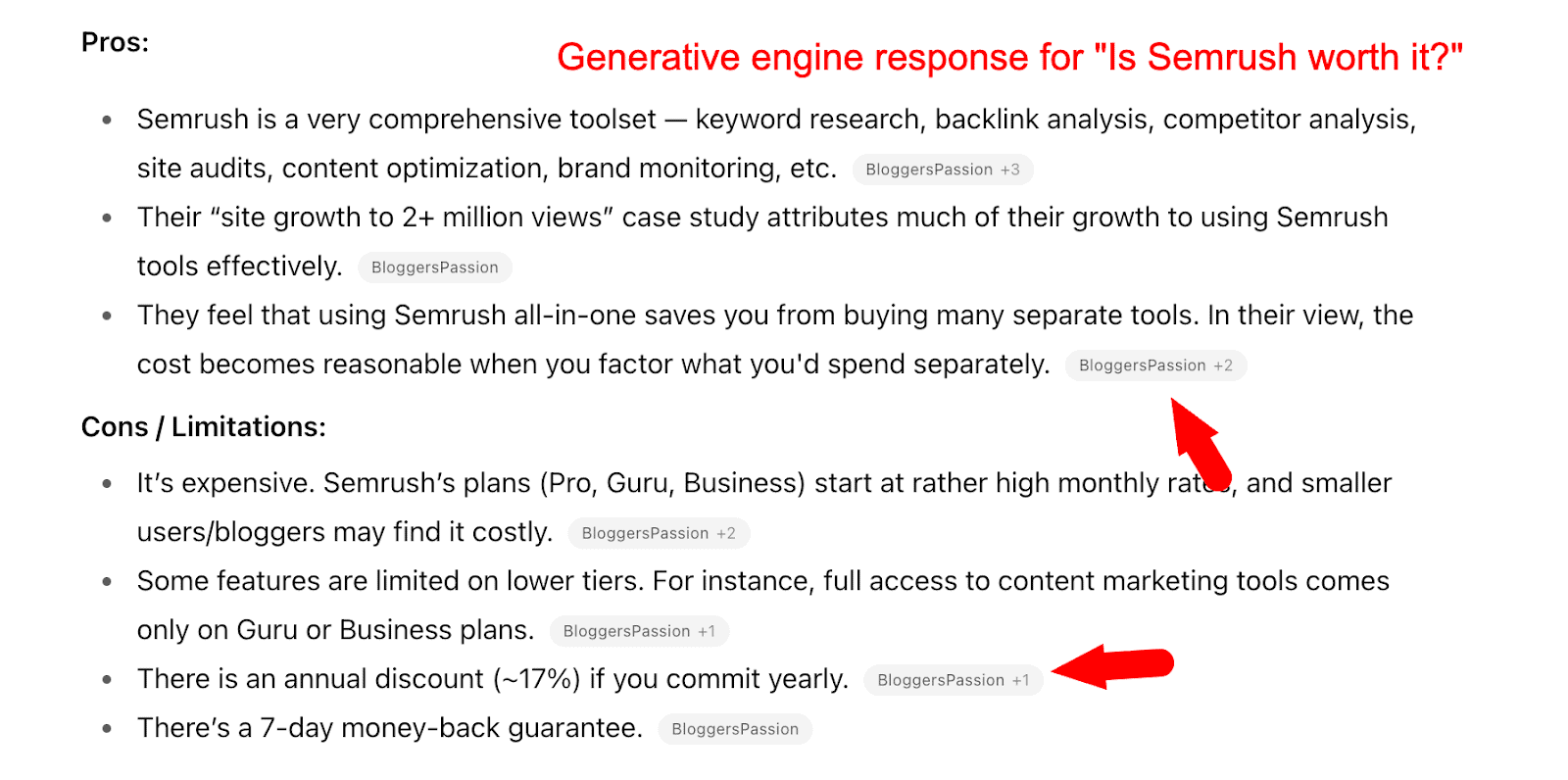
So, what’s the takeaway?
Adding schema to your website’s content is like providing AI a roadmap of your content. With schema markup, you make it easy for generative engines like ChatGPT to understand and display your content in AI-generated answers quickly.
If you’re a WordPress user, you can install the RankMath SEO plugin to add various types of schema to your site easily.
Here’s an excellent video by the RankMath team on how to set up and configure schema markup.
Use tools for AI analysis
What do you do when you want to improve your search rankings in SEO? You regularly monitor your keyword rankings, right?
Similarly, tracking your visibility in generative engines is just as important.
We use Semrush’s AI SEO Toolkit to see how our content performs in AI-generated answers across various platforms.
It helps us track our AI visibility in various generative engines, including ChatGPT, Perplexity, and Google’s AI Overviews.
Here’s what it looks like;
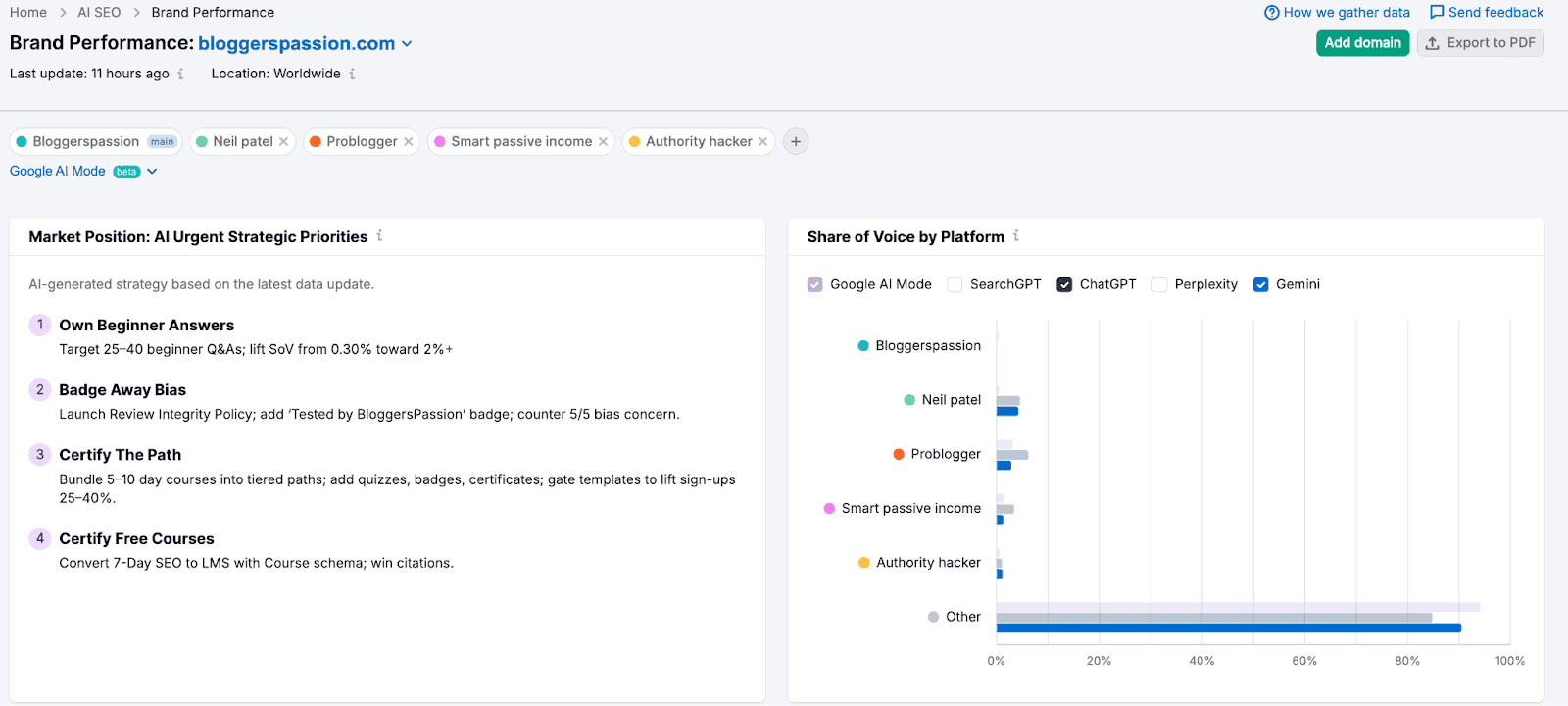
As you can see above, the tool provides AI-based tips, such as answering beginner questions to increase visibility in more searches, adding a trust badge to establish credibility, and creating free courses with quizzes, among others.
These insights help identify which pages are being cited, how often, and in what context.
What Are the Other GEO Ranking Factors in 2026
Just like SEO has ranking factors for search engines, GEO also relies on key signals that help AI platforms understand and select the best content for their answers. Optimizing your content around these factors increases your chances of being mentioned in AI-generated responses.
- Content clarity
- Brand mentions
- Author authority
- Freshness
- Structured formatting
- Entity recognition
- Citations from trusted sources
Related Reads:
- AEO in SEO
- AIO in SEO
- SEO vs. GEO, AEO, LLMO: All You Need to Know
Final Thoughts
Generative Engine Optimization is definitely changing the way people search for information online.
If you’re not optimizing for AI answers, you’re going to miss out on lots of traffic and brand visibility from AI platforms like ChatGPT, Perplexity, Gemini, etc. So, start taking action from now before it’s too late.
What do you think about the growing popularity of GEO? Are you optimizing for GEO to rank inside AI-generated answers? Have any questions? Let us know in the comments.
FAQs On GEO In SEO
Here are some of the commonly asked questions on Generative Engine Optimization.
GEO can’t completely replace SEO. However, it can supplement SEO, as you can rank your website in AI-generated answers, in addition to search engines.
GEO involves optimizing for AI-generated answers, whereas SEO focuses primarily on ranking your content on search engines.
GEO is essential because AI-generated answers are becoming increasingly popular, as people utilize AI tools to find products, information, and more.
Use structured data, include an FAQ section, use descriptive subheadings, and make sure your information is factually correct.
Certainly yes. If AI platforms regularly cite your website while providing information, you’ll see increased visibility and consistent traffic growth.






Leave a Comment
Your email address will not be published. Required fields are marked *